
Label Stock Ink Rub Test for Packaging and Printed Materials
Label stock plays a critical role in modern packaging. It carries branding, regulatory information, batch numbers, and usage instructions. When labels lose legibility due to abrasion, the consequences range from poor shelf appearance to serious compliance risks. That reality makes the label stock ink rub test an essential quality evaluation method for packaging professionals.
An ink rub test assesses how well printed information resists wear when subjected to repeated rubbing under controlled conditions. This introduction explains the principles behind ink rub testing, the relevance of ASTM D5264, and how marking durability rub test methods support reliable label stock selection across packaging supply chains.
Ink Rub Test and ASTM D5264 for Label Stock Evaluation
Ink Rub Test Fundamentals
An ink rub test simulates real-world friction that label stock experiences during shipping, storage, and handling. Printed labels may rub against cartons, other packages, conveyors, or pallets. Over time, these interactions can degrade ink layers or coatings.
During testing, a printed label specimen undergoes repeated rubbing cycles using a defined load and stroke length. After testing, evaluators inspect the specimen for ink loss, smearing, or reduced contrast. The test also examines ink transfer onto a receptor material, which reflects the tendency of ink to scuff or migrate.
This controlled approach helps manufacturers compare different inks, coatings, and label stock constructions under repeatable laboratory conditions.
ASTM D5264 and Marking Durability Rub Test Principles
ASTM D5264 serves as a widely recognized practice for measuring abrasion resistance of printed materials. The standard outlines how to mount specimens, apply specific weights, and run a defined number of strokes using a reciprocating rubbing motion. Each back-and-forth movement counts as one stroke, and test duration depends on the preset stroke count.
A marking durability rub test based on ASTM D5264 focuses on performance comparison rather than absolute pass/fail values. Test results typically compare a sample against an agreed reference specimen tested under identical conditions. This approach supports consistent communication between buyers, converters, and brand owners.
ASTM D5264 also emphasizes visual examination after testing. Evaluators assess the degree of print degradation on the label stock and the amount of ink transferred to the receptor. These observations directly relate to real packaging risks such as barcode unreadability or loss of regulatory text.
Why Ink Rub Resistance Matters for Label Stock
Abrasion resistance ranks as a critical property for printed label stock. Damage can occur at multiple stages, including:
- Transport vibration and carton-to-carton contact
- Automated labeling and filling operations
- Warehouse stacking and pallet movement
- End-use handling by consumers
Ink rub damage reduces product appearance and compromises information clarity. In regulated industries such as food, pharmaceuticals, and medical devices, poor marking durability can trigger compliance issues or product recalls.
ASTM D5264-based ink rub test methods provide a practical way to compare abrasion resistance while accounting for variables such as substrate type, ink formulation, coatings, and laminations.
Test Procedure Overview for Ink Rub Testing
Although laboratories may adapt setups to match specific needs, most ink rub tests follow a consistent workflow:
- The printed label stock mounts securely on a test base with a rubber pad.
- A receptor material attaches to a defined weight, commonly 0.91 kg or 1.81 kg.
- The test system runs a preset number of rubbing strokes.
- After completion, the specimen undergoes visual inspection for ink degradation.
- The receptor undergoes evaluation for ink transfer.
This process provides repeatable data that supports material selection, supplier qualification, and ongoing quality control.
Instrumentation and Testing Solutions
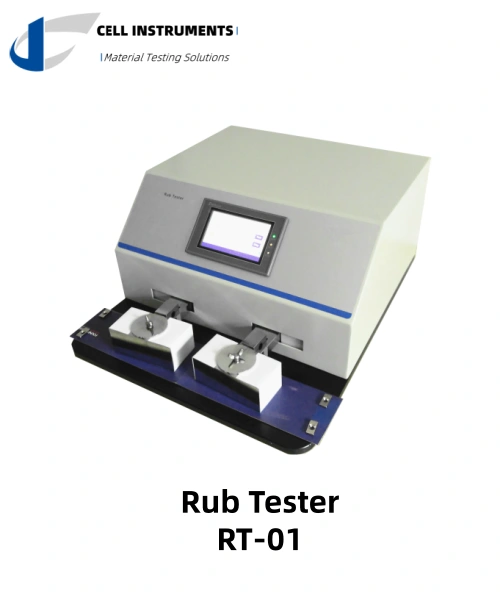
Reliable results depend on precise motion control, consistent loading, and accurate stroke counting. Modern ink rub testers improve repeatability and reduce operator influence. For packaging and label applications, Cell Instruments’ RT-01 Rub Tester provides a practical solution for ASTM D5264-based testing.
The RT-01 supports controlled rubbing cycles, standardized weights, and stable specimen mounting. Quality teams use it to evaluate label stock durability, compare ink systems, and establish internal acceptance criteria aligned with marking durability rub test requirements.
Supporting Quality Decisions in Packaging
Ink rub testing does more than generate laboratory data. It supports informed decisions across design, procurement, and production. By applying ASTM D5264 principles, companies ensure that label stock maintains legibility and appearance throughout its lifecycle.
For converters, brand owners, and quality control personnel, a clear understanding of ink rub test methods strengthens communication and reduces risk. With appropriate test equipment and standardized practices, label durability becomes a measurable, manageable property rather than an uncertainty.
 JA
JA  EN
EN  AR
AR  BG
BG  CS
CS  DA
DA  DE
DE  EL
EL  ES
ES  ET
ET  FI
FI  FR
FR  HU
HU  ID
ID  IT
IT  KO
KO  LT
LT  LV
LV  NB
NB  NL
NL  PL
PL  PT
PT  RO
RO  RU
RU  SK
SK  SL
SL  SV
SV  TR
TR  UK
UK