
Printed labels play a crucial role in packaging, offering branding, instructions, and regulatory information. However, the durability of the printed markings is just as essential, as they often undergo wear and tear during shipping, storage, and handling. This is where the ink rub test comes into play.
The ink rub test evaluates the abrasion resistance of printed labels, ensuring that the ink used for printing does not degrade easily under real-world conditions. By measuring how well the printed markings withstand rubbing or friction, manufacturers can determine if their labels will remain legible and visually appealing throughout the product’s lifecycle.
What is the Ink Rub Test?
The ink rub test, often referred to as the marking durability rub test, is a standardized method used to assess the abrasion resistance of printed materials. In particular, the test helps determine how resistant printed ink on printed labels is to smudging, fading, or rubbing off. The procedure simulates real-life conditions where printed materials experience friction, such as during shipping, storage, and handling.
The ASTM D5264 standard outlines this test, providing a structured way to evaluate the durability of ink and coatings used on printed labels. The test measures how much ink is transferred from the label onto a receptor after a series of rubbing actions. This test is particularly critical for industries where the legibility of labels is paramount, such as in food packaging, pharmaceuticals, and consumer goods.
How Does the Ink Rub Test Work?
The ink rub test involves the following key steps:
- Test Setup: The printed label sample is mounted on a rubber pad on the Sutherland base, with the receptor placed on top. A specific weight, typically either 0.91 kg (2 lbs) or 1.81 kg (4 lbs), is applied to the sample. The test conditions, such as the number of strokes (the back-and-forth motion of the machine), are preset according to the standards.
- Test Procedure: The Sutherland machine begins rubbing the printed label in a cyclic manner, with each stroke representing a rub back and forth. The test runs for a predetermined number of strokes, which ensures consistency in measuring abrasion resistance. Once the desired number of strokes is completed, the machine stops automatically.
- Examination of Results: After the test, the label is removed from the machine, and the degree of ink degradation is evaluated. The receptor is analyzed to check for any ink transfer, which indicates how much of the printed ink has been rubbed off during the test.
- Comparison to Standards: The results are compared to a predetermined standard to determine if the printed labels meet the required durability. The labels that show minimal degradation and ink transfer are considered to have high abrasion resistance.
Significance and Use of the Ink Rub Test
The ink rub test is significant for several reasons:
- Ensuring Product Durability: The test helps evaluate the durability of printed labels, which is especially important for items that will be subjected to heavy handling or extended exposure to wear and tear. Labels used in shipping, retail, or consumer-facing packaging need to be robust enough to maintain their appearance and legibility.
- Quality Control: For manufacturers of printed labels, the ink rub test serves as an important quality control measure. By regularly testing their labels for abrasion resistance, manufacturers can ensure that their products will meet customer expectations and comply with industry standards, like ASTM D5264.
- Protecting Brand Integrity: If the labels degrade too easily, the ink can smudge or fade, leading to poor product presentation and loss of brand recognition. High-quality printed labels with strong abrasion resistance maintain the integrity of the branding and information.
- Standardization: Following the ASTM D5264 standard provides a universal method for assessing ink rub resistance, ensuring that products are consistently evaluated, regardless of location or testing lab. This allows for better benchmarking across the industry.
The Role of the Cell Instruments RT-01 Ink Rub Tester
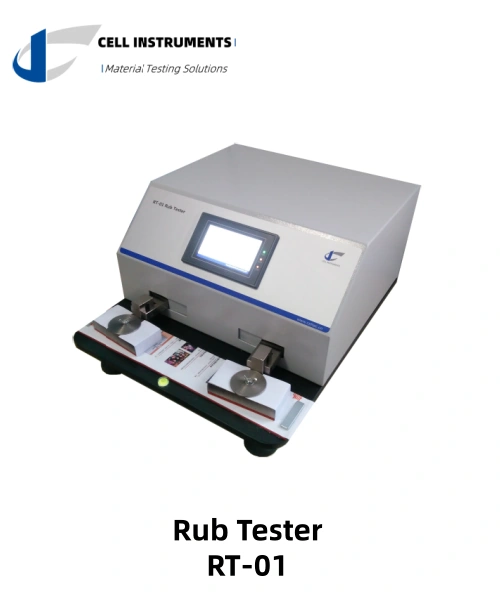
To perform the ink rub test effectively and accurately, it is essential to use reliable testing equipment. The Cell Instruments RT-01 Ink Rub Tester is specifically designed to carry out this test with precision.
The RT-01 Ink Rub Tester offers several advantages:
- Precision and Accuracy: It ensures that the rubbing force is applied uniformly, giving reliable and consistent results.
- Adjustable Settings: It allows users to customize parameters such as stroke count and weight applied, providing flexibility in testing different types of inks and materials.
- Ease of Use: With its user-friendly interface, the tester is easy to operate, making it ideal for use in both research and quality control environments.
By using the Cell Instruments RT-01 Ink Rub Tester, manufacturers can easily test the abrasion resistance of their printed labels and ensure they meet durability standards. This ensures that their products will not only look good on the shelf but will maintain their appearance even under challenging conditions.
Conclusion
The ink rub test is a vital test for ensuring the durability and performance of printed labels. By assessing how well printed inks withstand rubbing or friction, manufacturers can ensure that their products meet the necessary durability requirements for shipping, handling, and consumer use. Following the ASTM D5264 standard provides a structured and reliable method for performing these tests, and the Cell Instruments RT-01 Ink Rub Tester offers a precise and efficient solution for measuring abrasion resistance. By prioritizing the marking durability rub test, manufacturers can create high-quality, long-lasting printed labels that maintain brand integrity and provide consumers with reliable product information.
 RU
RU  EN
EN  AR
AR  BG
BG  CS
CS  DA
DA  DE
DE  EL
EL  ES
ES  ET
ET  FI
FI  FR
FR  HU
HU  ID
ID  IT
IT  JA
JA  KO
KO  LT
LT  LV
LV  NB
NB  NL
NL  PL
PL  PT
PT  RO
RO  SK
SK  SL
SL  SV
SV  TR
TR  UK
UK