
Plastic Film Packaging Printing Test and Its Importance
In the packaging industry, visual clarity and durability of printed labels are critical. From plastic pouches to laminated sachets, printed surfaces must withstand friction during transportation, handling, and storage. This is where the plastic film packaging printing test, especially the sutherland rub test, plays a pivotal role.
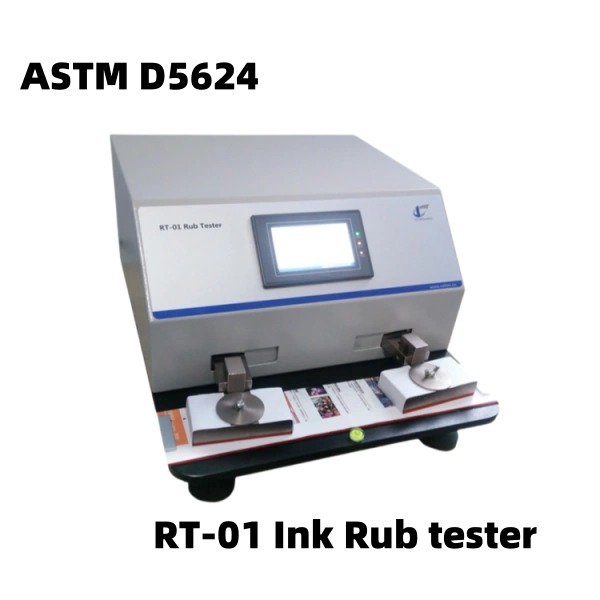
Designed specifically to evaluate the abrasion resistance of printed materials, the sutherland rub test ensures your printed packaging can endure real-world wear without compromising brand integrity or product information legibility. Cell Instruments’ RT-01 Ink Rub Tester, engineered in compliance with ASTM D5264, provides a dependable solution for this purpose.
Understanding the Sutherland Rub Test
The sutherland rub test is a standardized method to determine the resistance of printed materials to rubbing-induced wear. Governed by ASTM D5264, this method mimics real-world abrasion scenarios under controlled lab conditions.
This test involves mounting a printed specimen on a rubber pad affixed to the base of a Sutherland rub tester. A receptor, often an unprinted or printed sheet of similar material, is attached to a weighted block and placed in contact with the specimen. The tester is set to complete a predetermined number of back-and-forth rubbing cycles (strokes), after which the degree of print degradation and ink transfer are analyzed.
By simulating consistent abrasion conditions, the sutherland rub test provides a reliable way to compare ink durability, substrate quality, and coating performance.
Why Perform the Sutherland Rub Test?
Abrasion damage in packaging can significantly affect both appearance and readability. This test is essential for:
- Quality assurance of printed packaging materials
- Comparative analysis of inks, laminates, and coatings
- Evaluating print integrity after environmental exposure or transport
- Meeting buyer-supplier abrasion resistance criteria
In industries such as pharmaceuticals, food & beverage, and electronics, maintaining label legibility is not just aesthetic—it’s regulatory.
How to Conduct the Sutherland Rub Test According to ASTM D5264
A successful sutherland rub test hinges on strict adherence to procedure:
1. Apparatus and Setup
- Sutherland Rub Tester (e.g., Cell Instruments RT-01 Ink Rub Tester)
- Receptor paper (51×178 mm or 51×102 mm)
- Rubber pads with Shore A 15 ± 5 hardness
- Controlled environment: 23°C ± 1°C, 50% ± 2% RH
2. Sample Preparation
- Cut specimens to 76×152 mm; ensure uniform ink density and no surface defects.
- Handle samples with care to prevent contamination.
- Condition the samples in a standardized environment for at least 24 hours.
3. Mounting and Test Execution
- Attach the test sample and receptor securely.
- Preset the tester for the desired stroke count (usually 25, 50, or 100).
- Run the test. The machine will stop automatically after the preset strokes.
- Repeat the process for all test samples and reference standards.
4. Evaluation
- Examine print degradation visually or via colorimetric comparison.
- Assess ink transfer to the receptor.
- Compare results against reference samples or acceptance criteria.
Advantages of Using the Cell Instruments RT-01 Ink Rub Tester
The RT-01 Ink Rub Tester from Cell Instruments is a precise, ASTM D5264-compliant device ideal for plastic packaging printing test applications. Its key advantages include:
- Digital stroke counter for precise cycle control
- Multiple weight options (2-lb and 4-lb) to simulate different shipping stresses
- Adjustable stroke speed for flexible test customization
- Compact and robust design, suitable for lab and production settings
When precision and consistency matter, the RT-01 is a reliable choice for quality control professionals in printing, packaging, and converting industries.
Best Practices for Reliable Results
To ensure the validity of test outcomes:
- Regularly replace rubber pads to avoid surface hardness variability.
- Select appropriate receptor types based on packaging substrates.
- Avoid excessive strokes that may generate heat and distort results.
- Keep the tester clean and free of particulate contamination.
- Use anti-static brushes to eliminate dust before each test.
Conclusion
The sutherland rub test is indispensable for verifying the abrasion durability of printed packaging materials. For companies aiming to uphold high quality standards and regulatory compliance, especially in sensitive sectors like medical devices and pharmaceuticals, this test is non-negotiable.
Backed by ASTM D5264 and enabled by reliable tools like the RT-01 Ink Rub Tester from Cell Instruments, the plastic packaging printing test becomes not only a routine procedure but a strategic quality control tool.
 EN
EN  AR
AR  BG
BG  CS
CS  DA
DA  DE
DE  EL
EL  ES
ES  ET
ET  FI
FI  FR
FR  HU
HU  ID
ID  IT
IT  JA
JA  KO
KO  LT
LT  LV
LV  NB
NB  NL
NL  PL
PL  PT
PT  RO
RO  RU
RU  SK
SK  SL
SL  SV
SV  TR
TR  UK
UK