Sutherland rub test
ASTM D5264
Om oss
ASTM D5264
Sutherland Rub Test
ASTM D5264 is a standardized testing method used to evaluate the ink abrasion resistance of printed materials. It is commonly known as the Sutherland rub test, and it provides a controlled laboratory method to simulate rubbing, handling, and transport-related wear.
Testa nötningsbeständigheten hos trycksvärta eller beläggning
Overview of ASTM D5264 Ink Abrasion Evaluation
In the printing and packaging industries, ASTM D5264 plays a critical role in assessing how well inks, coatings, and printed surfaces withstand mechanical abrasion. The test is widely used in quality control to ensure that printed information remains legible throughout the product lifecycle.
This method is especially important for packaging, labels, and commercial printing applications where surface durability directly affects product appearance and usability.
Test av bläckets nötningsmotstånd
Test Principle of ASTM D5264 Sutherland Method
Den Sutherland rub test operates on a simple mechanical abrasion principle:
A printed specimen is mounted on a rubber pad, while a weighted receptor sheet is placed on top. The device applies controlled reciprocating motion, generating friction between the two surfaces.
Key performance indicators include:
- Ink transfer level to receptor
- Degree of print fading or smearing
- Surface coating degradation
- Resistance consistency over repeated strokes
The number of strokes is pre-set, and the test automatically stops once the cycle is completed.
This makes ASTM D5264 highly repeatable for evaluating ink abrasion resistance under controlled laboratory conditions.
Test av bläckets nötningsmotstånd
Test Procedure of ASTM D5264
1. Specimen Preparation
Printed samples are cut to fit the Sutherland base and mounted securely on the rubber pad to prevent movement during testing.
2. Receptor Setup
A receptor sheet is attached to a weighted assembly (typically 2 lb or 4 lb depending on test requirements).
3. Machine Configuration
The required number of strokes is set on the ink rub tester, ensuring consistent abrasion cycles for all samples.
4. Abrasion Testing
The machine is activated, and the specimen undergoes reciprocating rubbing against the receptor under controlled pressure.
5. Evaluation
After testing, both the specimen and receptor are analyzed: Printed surface is inspected for degradation Receptor is checked for ink transfer level Results are compared with reference standards
This procedure ensures consistent evaluation of ink abrasion resistance tester performance across different materials.
Applications of ASTM D5264 in Printed Materials
ASTM D5264 is widely used across industries where print durability is critical:
- Packaging printing (cartons, flexible packaging, labels)
- Food and beverage packaging
- Pharmaceutical labeling
- Commercial printing products
- Industrial instruction labels
- Coated and laminated surfaces
In all these applications, sutherland rub test results directly reflect how printed information will perform during shipping, storage, and end-use handling.
Importance of Ink Abrasion Resistance Testing
The importance of ink abrasion resistance tester evaluation lies in product reliability and brand protection.
Key benefits include:
- Ensuring long-term readability of printed information
- Preventing smearing or fading during transportation
- Improving product appearance and consumer trust
- Supporting ink formulation development
- Enabling standardized supplier comparison
ASTM D5264 provides a consistent benchmark for evaluating these performance factors under controlled laboratory conditions.
Cell Instruments RT-01 Rub Tester for ASTM D5264
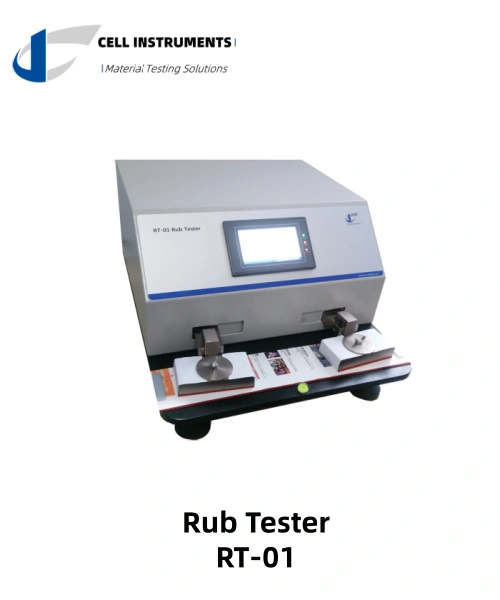
Den Cell Instruments RT-01 Rub Tester is designed to support standardized ASTM D5264 sutherland rub test procedures for ink and coating evaluation.
Key advantages include:
- Precise control of rubbing stroke count and speed
- Stable pressure loading for consistent abrasion force
- Supports standardized ink abrasion resistance tester evaluation
- High repeatability for quality control environments
- Suitable for inks, coatings, laminates, and printed substrates
The RT-01 helps laboratories and manufacturers accurately assess sutherland rub test performance while improving testing efficiency and reproducibility.
FAQs
Q1: What is ASTM D5264 used for?
ASTM D5264 is used to evaluate ink abrasion resistance of printed materials. It measures how well inks, coatings, and printed surfaces withstand rubbing, handling, and transport-related wear using the sutherland rub test method.
Q2: What is the sutherland rub test?
An ink rub tester is the instrument used to perform ASTM D5264 testing. It applies controlled reciprocating motion and pressure between the specimen and receptor to measure ink abrasion resistance under standardized conditions.
Q3: What materials can be tested under ASTM D5264?
This method is suitable for printed paper, cartons, labels, coated films, laminated packaging, and other printed substrates used in packaging and commercial printing industries.
Q4: Why is ink abrasion resistance important? Ink abrasion resistance ensures that printed information remains readable during shipping, storage, and end use. Poor resistance may cause fading, smearing, or loss of product identification.
Ink abrasion resistance ensures that printed information remains readable during shipping, storage, and end use. Poor resistance may cause fading, smearing, or loss of product identification.
 SV
SV  EN
EN  AR
AR  BG
BG  CS
CS  DA
DA  DE
DE  EL
EL  ES
ES  ET
ET  FI
FI  FR
FR  HU
HU  ID
ID  IT
IT  JA
JA  KO
KO  LT
LT  LV
LV  NB
NB  NL
NL  PL
PL  PT
PT  RO
RO  RU
RU  SK
SK  SL
SL  TR
TR  UK
UK