Understanding the Role of Rubbing Fastness in Material Performance
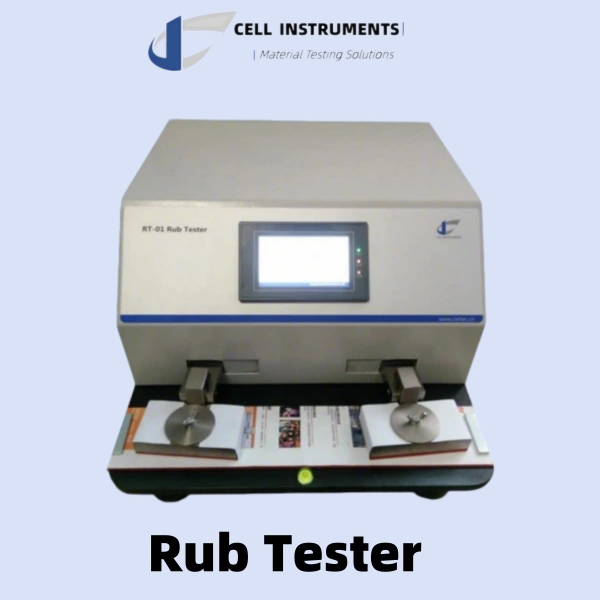
In modern packaging, printing, and labeling industries, the abrasion resistance of printed materials is a critical property that directly affects product quality, legibility, и brand appearance. As materials move through shipping, handling, and end-use environments, printed surfaces are often subject to rubbing, friction, and mechanical wear.
This is where a rubbing fastness machine becomes essential. Designed to simulate real-world scuffing or rubbing, this instrument enables manufacturers and quality control teams to assess how well inks, coatings, and printed surfaces withstand mechanical wear over time.
At Cell Instruments, we understand how vital it is for industries such as food packaging, pharmaceuticals, daily chemicals, and electronics to guarantee the appearance and readability of their printed materials. That’s why we offer high-precision rubbing fastness testers that help professionals conduct reliable, standardized tests—especially according to ASTM D 5264, the global benchmark for rub resistance testing.
ASTM D 5264: Standard for Rub Resistance Testing
The industry-recognized ASTM D 5264 standard defines the test method for evaluating the abrasion resistance of printed materials using a rubbing fastness machine, commonly referred to as a Сазерленд Руб-Тестер.
According to ASTM D 5264:
- The printed specimen is mounted on a rubber pad.
- A receptor (unprinted or printed material) is attached to a weighted arm.
- The rubbing fastness machine applies a controlled back-and-forth motion (stroke).
- After a predetermined number of strokes, the test sample and receptor are evaluated for degradation or ink transfer.
This method is particularly useful in comparing different printing technologies, ink formulations, laminates, и substrates under uniform laboratory conditions.
How to Conduct a Rubbing Fastness Test
Proper implementation of the ASTM D 5264 procedure ensures accurate and repeatable results. Here’s how to conduct the test using a rubbing fastness machine such as the Cell Instruments RT-01:
Step-by-Step Testing Procedure
- Prepare the Test Environment
Maintain testing conditions at 23 ± 1°C и 50 ± 2% RH as specified in ASTM D4332. - Подготовка образцов
Cut the specimen to 76 x 152 mm (3 x 6 in.), ensuring no creases or contaminants. Align the sample so that rubbing occurs across the machine direction. - Mounting Components
- Place the sample face-up on the Sutherland base.
- Mount the receptor (unprinted substrate or identical print) on the underside of the weight using pressure-sensitive tape or clamps.
- Set Parameters
- Choose an appropriate weight: 0.91 kg (2 lb) or 1.82 kg (4 lb).
- Set the number of strokes (usually 25, 50, or 100, depending on product requirements).
- Run the Test
Activate the rubbing fastness machine. It will automatically stop after completing the preset number of strokes. - Evaluate Results
Examine both the sample and the receptor:- Check for ink degradation, loss of gloss, or substrate damage.
- Evaluate ink transfer onto the receptor using visual grading or colorimetric analysis.
Applications of Rubbing Fastness Testing
The rubbing fastness machine is a multifunctional instrument used across a wide range of industries. It helps validate the durability of printed packaging, labels, instruction manuals, and even decorative surfaces.
Key application sectors include:
- Pharmaceuticals: Ensures label readability for dosage and warnings.
- Food & Beverage: Maintains brand visuals and expiry details through distribution.
- Textiles: Tests print quality and dye fastness on fabric surfaces.
- Medical Devices: Validates information permanence on sterile packaging.
- Бытовая электроника: Prevents information wear-off during handling and storage.
Why Choose Cell Instruments‘ RT-01 Rubbing Fastness Machine
If you’re looking for a reliable, ASTM-compliant rubbing fastness machine, the RT-01 from Cell Instruments is an ideal solution. It supports:
- Precise control of stroke speed and count
- Compatibility with both 2 lb and 4 lb loads
- Adjustable sample holders for flexible specimen types
- Automatic shutoff и durable construction for repeatable testing
Our RT-01 rub tester is widely adopted in quality inspection labs, material R&D departments, и industrial production lines to ensure product integrity and regulatory compliance.
Tips for Better Test Accuracy
To ensure consistent and accurate results:
- Replace worn rubber pads regularly to prevent skewed outcomes.
- Avoid touching print areas with bare hands—finger oils can affect results.
- Keep the machine clean and calibrated.
- Используйте reference standards for comparison and validation.
Заключение
Сайт rubbing fastness machine is a critical tool for any organization that values the durability, clarity, and professionalism of printed materials. By following ASTM D 5264 test methods, manufacturers and quality control personnel can objectively evaluate abrasion resistance, mitigate product risks, and improve customer satisfaction.
For those seeking high performance and reliable compliance, the Cell Instruments RT-01 provides a practical, cost-effective solution to meet today’s rigorous testing demands.
Invest in better quality control. Invest in tested results. Invest in Cell Instruments.
 RU
RU  EN
EN  AR
AR  BG
BG  CS
CS  DA
DA  DE
DE  EL
EL  ES
ES  ET
ET  FI
FI  FR
FR  HU
HU  ID
ID  IT
IT  JA
JA  KO
KO  LT
LT  LV
LV  NB
NB  NL
NL  PL
PL  PT
PT  RO
RO  SK
SK  SL
SL  SV
SV  TR
TR  UK
UK